
www.savagechickens.com
Assuming that you haven’t been living in a cave, or haven’t been enjoying some wonderful vacation in a remote location without internet access (they exist), by now, you’ve probably heard of EHV-1,. the [horrible, deadly, awful, terrible] disease that pops up regularly around the world, including one infamous incident that occurred at a cutting horse show in Ogden, Utah, at the end of April 2011, all sorts of other places during the next decade, in February 2021, in Spain, resulting in all sorts of horse show closures, and most recently, in 2022, at the Desert Horse Park in Thermal, CA.
And you may be very worried. Very, very worried. Especially since it keeps turning up regularly, every year.
So let’s discuss this and see if we can bring some calm to the waters that are stirred because of legitimate concerns.
 EHV-1 stands for “Equine Herpes Virus-1.” It’s given the “1” because there are several herpes viruses that affect horses, and even several strains of EHV-1, including one in particular that seems to like the nervous system (the “neuropathogenic” strain). This “1” was apparently first in line when it came to giving out names. Other than that, the “1” has no significance of which I am aware.
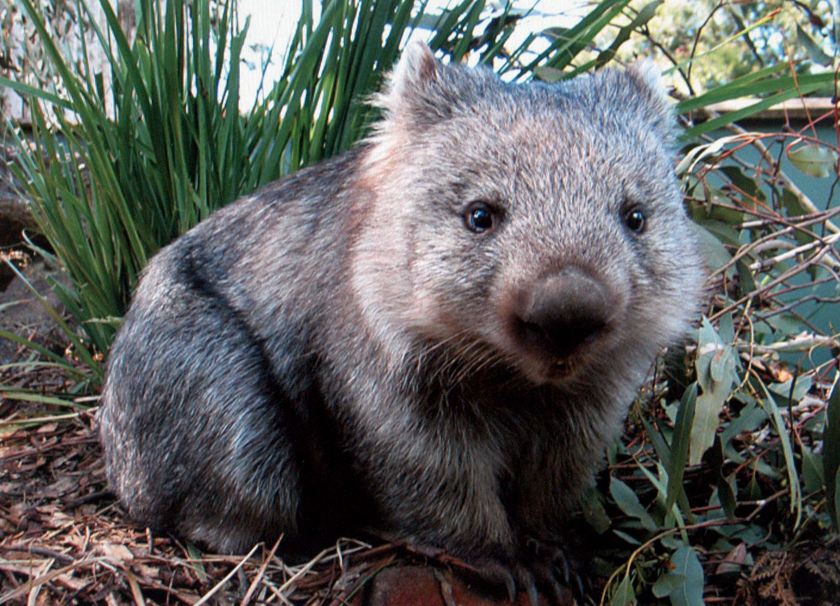
A young wombat, which may or may not carry a herpes virus, but it almost preternaturally cute
Herpes viruses are arguably the most successful of all the viruses, if you measure success in terms of how many of them there are, and how many mammalian species are affected. There are herpes viruses of horses, and people, and dogs, and cats, and pigs, and cattle, and, for all I know, kangaroo, camels, and wombats, too. They are successful for two primary reasons.
REASON ONE FOR THE SUCCESS OF HERPES VIRUSES – They usually don’t hurt the host very much. That’s right, most of the time, herpes viruses are unnoticed by the host. It doesn’t do a virus much good to go killing off its host – that’s at least one reason why it’s thought that Ebola virus isn’t spreading rapidly around the world. If the host doesn’t live, the virus can’t spread. Mostly, herpes viruses don’t cause much fuss. They are sort of like the quiet family that lives in the dark house down the street, or in the apartment down the hall. If you didn’t know that they were there, you wouldn’t know that they were there. Most of the time.
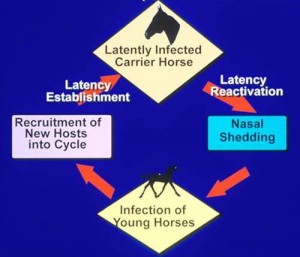 REASON TWO FOR THE SUCCESS OF HERPES VIRUSES – They have (very cleverly) figured out how to evade the body’s immune system. Once a horse (or wombat, etc.), gets infected with a herpes virus, the virus finds a nice home, usually in and around nerves. There, they stay nice and quiet (medical folk say latent), until some stress causes the virus to activate and start causing trouble. And the fact that they can evade the body’s immune system also means that, so far, nobody has been able to develop an really effective vaccine against them.
READ THAT AGAIN: So far, nobody has been able to develop a really effective vaccine against herpes viruses. In any species. They’re trying. So far, no luck.
NOTE: Yes, I know that there are vaccines available for horses against two strains of equine herpes viruses, EHV-1 and EHV-4. These are to try to help prevent respiratory disease and to try to help prevent abortions in pregnant mares. They are required to go to horse shows. However, their true effectiveness is a source of great debate in the veterinary community. I’m just sayin’.
Do you get cold sores? Something like 70% of the human population does. Most of the time, people with cold sores have perfectly normal looking lips. But add some stress – say, illness, tax returns, school (for kids) – and, BOOM,

Ideal conditions for starting a disease outbreak
you end up with a big, painful knot on your lip. Then, the body fights it off, and the virus goes latent, waiting for another stressful opportunity.
In horses, depending on the study you read, it’s estimated that as many as 50% (or more) carry the latent EHV-1 virus in some form. And, stress can help activate a latent virus. So, in some sense, back in 2011, sending 700-some horses to Ogden, Utah to compete in a horse show – or to any horse show – was the equine equivalent of sending the kids to school. So was sending horses to the veterinary hospital at Cornell University earlier that year. The same with the horses in Spain in 2021 or Thermal in 2022. In fact, most EHV-1 outbreaks occur in groups of horses. Take group of horses, get them excited, stressed, and packed together, and you’ve got an absolutely perfect setting for the herpes viruses to come out and play. In these outbreaks, some poor horse – one of hundreds that are probably carrying the virus – stressed, and far away from home, broke with the virus, which reproduced, and then spread to other horses. Think kids in school with a cold: one of them gets sick, and before you know it, everyone gets sick. It’s a scenario that gets repeated several times a year.
Remember when I said that herpes viruses usually don’t hurt the host very much? Well, that’s usually true. Unfortunately, in some horses, some strain of the EHV-1 virus (and not necessarily just the neuropathic one) gets into the horse’s nervous system and causes a great deal of mischief. It can even cause a horse to die. Dying as a result of an infection is horrible, and it’s one legitimate reason that people worry so much about this virus. However, bad results can occur even relatively benign viruses. Remember, even though most people think of the “common cold” virus as a mild annoyance that they have to suffer through for a week or so once in a while, people do also die from that same virus. The “uncommon” cold, as it were.
If you surf the internet reading about the EHV-1 virus, you’ll come across lists of problems that it causes. You’ll read stuff like, “Symptoms include fever, decreased coordination, nasal discharge, urine dribbling, loss of tail tone, hind limb weakness, leaning against a wall of fence to maintain balance, lethargy, and the inability to rise.” I guess that’s strictly true, but focusing only on the worst effects is kind of like saying the common side effects of taking a bath include drowning. You shouldn’t always focus on the worst possible outcomes, even if they do occasionally happen. It’s like this clip, from the old movie, “Kindergarten Cop.”
Most horses that get exposed to the EHV-1 virus, no matter what strain, DON’T get neurologic disease. In the big outbreaks that have been tracked, a bit more than 10% of the horses in the outbreak got the virus, and about 15% of those ended up dying. Using those statistics, if you started with 1000 horses, you’d have 100 affected, and 15 that died. That’s absolutely terrible if you’re the owner of a dead horse, of course, and I don’t want to minimize how horrible it is to lose a horse to EHV-1. But the point is that even in the worst outbreaks, 90% of the horses don’t get seriously ill, and of those, most recover.
The bottom line? Most of the horses that were exposed to the EHV-1 virus are going to be OK. And if you really want to get into the particulars, you can see a great FAQ sheet from the California Department of Food and Agriculture if you CLICK HERE. Mostly, even if a horse gets EHV-1, it’s going to be OK, with rare, albeit sometimes awful and tragic, exceptions. In fact, most of the time, you won’t even know.
Of course, no one wants any horse to get sick, ever, so, understanding that, your reasonable question would be, “What can/should we do?”
And my first response would be, “Go out and enjoy your horse.”

Arguably worse than EHV-1 for most horses
Are you going to stop driving because people die in auto accidents? Going to stop flying because occasionally airplanes crash? (Well, actually, some people do, but that’s a psychiatric discussion.) One of the many uncomfortable facts of horse life (besides, say, having to dress up in costumes, or wear brightly colored blankets, boots, etc.), is that the EHV-1 virus is pretty much everywhere. Your horse has probably already been exposed at some point in his life. The virus has been identified in 5 week old foals, who pass it back and forth with their mums (at least in Australia).
“But what about prevention?” you say. Prevention is great. The first place that people tend to turn is to vaccination. Unfortunately, when it comes to the neurologic disease occasionally caused by EHV-1, vaccination won’t help. Vaccination simply is not effective at preventing the EHV-1 infections that make all the headlines.
But there is are certainly things that you can do. Since there isn’t an effective vaccine,  the best things that you can do to prevent EHV-1 infections involve good biosecurity measures, that is, the types of things that people should do with their horses anyway (but often don’t).
So, for example, new arrivals to farms should be quarantined for a few weeks before being introduced to new horses. People working around horses should wash their hands often so that they don’t carry disease from horse to horse. If you’re working around a sick horse, change your clothes before moving on to the next horse. If you’re going to a show, avoid letting your horse hang out with horses you don’t know. Don’t crowd horses together in confined spaces. Feed them well. Don’t let them share waterers. Take their temperatures twice a day to pick up problems early when you’re at the show. Disinfect their stalls (dilute bleach is a great and cheap disinfectant). Get them fresh air and exercise. All common sense and mundane: important, too. CLICK HERE to see a great link on equine biosecurity measures.
I don’t want to seem unconcerned or insensitive. EHV-1 can be a very bad deal for individual horses. But for most horses, EHV-1 is no big deal at all. It’s one thing to be prudent and cautious, but it’s quite another thing to be hysterical. So, for example, avoiding horse shows in one state because there was an EHV-1 outbreak in another is akin to closing the Los Angeles Unified School District because some kids in Missouri got chicken pox (which, by the way, is another herpes virus).
 As if you didn’t feel helpless enough, there’s not any really effective treatment for the EHV-1 virus either. When horses get sick with EHV-1, they get “supportive” care until they get better (and most of them do get better). Antiviral therapy, using drugs like acyclovir, which us used to treat human cold sores, is available, but it only seems to help horses with EHV-1 if it’s given before clinical signs start. Plus, it’s really expensive.
The best news, in addition to the fact that most horses exposed to the EHV-1 virus will get better, is that most horses exposed to EHV-1 won’t get it at all, or will be very mildly affected (you might not even know they have it).
I understand that you don’t want your horse to get EHV-1, and, if you are one of the unfortunate few that have had a horse with an EHV-1 neurologic infection, you have my deepest and most sincere sympathies. Still, like most everything, the main key to dealing with the EHV-1 problem is to try to understand it, keep calm, and don’t panic.
Horses and EHV-1 have been living together for a long time. Chances are, they will continue to do so, in spite of our best efforts. And, finally, if you want lots more detail, there’s just been a great webinar on EHV-1 put on by the University of California, Davis, School of Veterinary Medicine, which you can see if you CLICK HERE.
Knowledge is power. At least to a point.