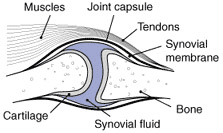
 The framework of your horse’s body is the skeletal system, made up of bones. Anywhere two bones meet, you’ll find a joint. In joints that move, such as the joints of the lower limbs, the ends of the bones joint are covered with a thin, white covering called cartilage. Cartilage is a smooth and resilient tissue that allows the ends of the bone to move with virtually no friction, and that also allows the forces placed on the joint to be spread uniformly across it. Cartilage is also very well hydrated, which helps to cushion the forces applied to the joint, in the same sort of fashion as a waterbed.
Surrounding the joint is a fibrous joint capsule. The fibrous joint capsule is the wrapping paper of the package that is the joint. Lining the joint capsule is a thin membrane, richly supplied with blood vessels, called the synovial membrane. The synovial membrane is a critically important structure, as it produces the synovial (joint) fluid that’s normally in joints, as well as the numerous inflammatory compounds that are present in diseased joints.
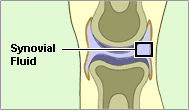 Synovial fluid is vital for joint health. This fluid has a number of functions, including lubricating the joint and the tissues that envelope it. But that’s not all that synovial fluid does. Synovial fluid also provides nutrition to the cartilage cells. Since normal cartilage has no blood vessels, lymph vessels, or nerves, anything that’s put into a joint – or into the horse – has to diffuse into the cartilage from the joint fluid to be able to have any effect on the cartilage. This means that anything that is put into the horse, or its joints, has to be in sufficient concentration, and stay for sufficient time, to be able to have any effect.
Since nutrients have to diffuse into cartilage, it can’t be very thick, or nutrients wouldn’t be able to get to all of the cartilage cells (otherwise stated, if cartilage were thick, nutrients would be unlikely to get to the deeper layers, just like cold temperature can’t get to your hands when you’re wearing a
Chance
thick pair of gloves). Furthermore – and this is a big problem for athletic horses – cartilage has only very limited ability to repair itself. Since cartilage is isolated from the body’s blood supply, it doesn’t have a very active metabolism (compared to, say, the skin). That means that cartilage cells don’t replace heal well when they are damaged. Instead, cartilage damage usually results in permanent damage to a joint, at least eventually. All of this means that a little damage to the cartilage can cause big problems.
More on Joints
The One Thing That Your Tackroom Shouldn’t Be Without
Bleach. Short article, right? Wait, there’s more! Let’s talk about some of the wonderful ways that you can use bleach around your horse. Bleach fits three wonderful criteria for something that you want to have in your tackroom because…
Is it Kind, Necessary, True, and Does It Improve Upon the Silence?
I will readily admit that I have not studied the religions and philosophies of India. Nevertheless, I find myself drawn to a quote that is attributed to Sai Baba, an Indian guru and yogi who lived in western India, and who died in 1918 (he’s…
Hoof Dressings
One question that seems to come up fairly often during the course of my practice is, “Which hoof dressing do you recommend?” I wish I had a good answer to that. It’s a hard question to answer anyway. A Google search of…
“Natural” Balance?
I am constantly amazed at people’s taste for “natural.” I mean, really, humans have spent most of their civilized life trying to get away from natural. Now it’s constantly being used as an advertising vehicle. I mean,…
Laminitis is NOT a Disease
Laminitis (or, “founder”, as it is often called) is, justifiably, one of the most feared medical and lameness conditions of the horse. I’ve been thinking about it a lot mostly because I just started taking care of two horses with…
Increasing Circulation (or not)
Have you ever heard the phrase, “Therapeutic intent?” Therapeutic intent refers to a specific endpoint that you’re looking for from a particular treatment. So, for example, if your horse has a bacterial infection, and you give…
Solving Your Shoeing and Trimming Worries
The horse’s foot is so important that they’ve even come up with a cliché about it. You know, “No foot, no horse.” Yada yada yada. But, as another cliché goes, “The devil is in the details.” The…
A Few Principles of Trimming and Shoeing
I don’t think that any area of the horse gets as much attention as the hoof. With well-intentioned regularity, the horse’s hoof gets picked, oiled, conditioned, supplemented, trimmed, and shod. And, that’s not to mention…
False Precision
There’s something that you need to be aware of in the horse world. It’s called “false precision.” Precision (true precision) requires that a specific action produces pre-defined and specific results. The basic premise…
Hoof Treatments
The idea that the horse’s hooves are important isn’t exactly new. People have been riding horses for something like 4,000 years, and it’s my guess that the time worn (out) phrase, “No hoof, no horse” was probably…