
There’s yet another entry that’s gained some steam in the lameness treatment field. This one is a preparation that’s made from the horse’s own blood (as is IRAP), and, like most things, it comes with a lot of “promise” but very little in the way of good evidence at the moment. But it is the latest latest thing: it has been performed a good bit in human athletes, too. It is known as Platelet-Rich Plasma (PRP), and I most recently attended a brief discussion on it at the AAEP Focus on Soft Tissue Lameness in New Orleans, Lousiana, in July, 2016, but have been watching the medical literature (human and veterinary) for years.
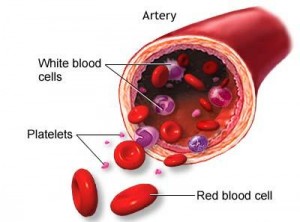
When a blood vessel starts to bleed, platelets are the first line of defense in plugging the hole
Platelets are the special cells that help plug up blood vessels when horses start to bleed. But what makes platelets so alluring – at least to those that are advocating their use – is that they also contain numerous “growth factors.” Growth factors certainly exist, but pinning them down as to what exactly they are and what exactly they do seems to be rather elusive. Otherwise stated, we know that they’re there, but we don’t always known which ones are there, or in what quantities, or just exactly what their function is. Generally, however, growth factors can be described as substances in the body that stimulate cell growth (and that is said to be good).
What’s quite certain is that because of these factors, the sports medicine and athletic communities have looked at PRP, and other, similar products, as very exciting: a potential way to help injured tissues heal. In fact, it’s so exciting that the sports medicine community seems to be falling all over themselves to provide endogenous growth factors directly to the injury site. Autologous (that is, the cells come from your horse) blood products such as PRP at least have the potential to help speed up healing of tendon and ligament injuries (which are notoriously slow to heal), and joint injuries and osteoarthritis, too. They have the potential to help get horses back to work faster, and with better outcomes. In fact, that potential is almost exactly the same rationale as is used for stem cells: or pretty much everything, when you think about it.
 PRP is obtained by spinning whole blood down in a tube (it’s a little more complicated than that, but not much more complicated than that). When you do the spinning, you concentrate the cells at the bottom of the tube – the heavier cells pack into the bottom, below the lighter liquid portion of the blood. And you can then get the platelets out – the PRP has a higher concentration of platelets in it than does whole blood.
And, honestly, it all sounds great. But, in spite of what-seems-to-be pretty widespread interest, and what seems to be pretty widespread use (especially in human athletes), the evidence is having a pretty hard time living up to the potential. Good evidence that looks at how well the treatment actually works is sorely lacking (in humans AND horses). There’s been some basic science, and a few horse studies, but there’s no consistent evidence that’s accumulated to show that PRP injections are better than the stuff that we’ve been doing all along. Let’s look at some of it.

4. At least they don’t seem likely to hurt.
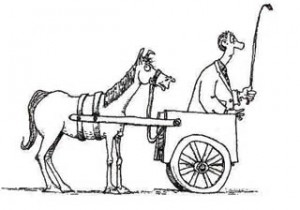 So here’s my take on things. When it comes to PRP injections, the cart is very far out in front of the horse. I think that good trials need to be conducted before people start paying large amounts of money for a treatment that hasn’t been shown to do anything (well, I guess that horse is already out of the barn, but still….) Veterinarians need to know about which injuries may benefit, the effectiveness, and the safety of PRP. But that’s not all:
1) Nobody knows what the “right” volume of injection is
2) Nobody knows what (if any) is the most effective preparation (there are several ways to make the product)
 3) No one knows the ideal injection technique. For example, should it all be put in one spot, or should multiple spots be use?
4) Nobody knows the optimum timing of the injections in relation to the time of injury
5) Nobody knows if 1 PRP injection is enough, or if a series of injections would be better
With PRP, you have a treatment of unknown benefits, and a sure cost. There’s not currently any indication that PRP injections offer any benefits over a good rehabilitation program. There’s no indication that for joint problems, PRP offers any benefits over currently available therapies – it’s just more expensive. Fortunately, based on the few publications out there, the risks of PRP injections seem to be very low, however, the benefits remain unproven at this point in time.
No therapy is completely successful, and all carry some degree of risk. However, personally, I think that medicine should be more than, “You pays your money and you takes your chances.” Currently, in spite of all of the promise and potential, with PRP, you’re paying for a lot of promise, but not any proven results.