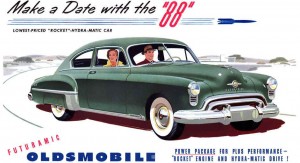
Your dream car, 1949
I cannot speak, from personal experience, about anything that happened in 1949. The average cost of new house was $7,450.00. The average wages per year were $2,950.00. The cost of a gallon of gas was 17 cents, and the average cost of a new car was $1,420.00 . The minimum Hourly Wage Rate was 70 cents per hour, but that was OK, because food was cheap; a pound of bacon cost 50 cents.
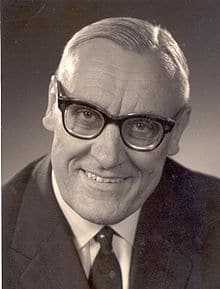
The one and only Ludwig Heilmeyer
Something else very important happened in 1949. Scientist Otto Gsell of Switzerland and Ludwig Heilmeyer of Germany found that a certain compound reduced redness in the inflamed skin of guinea pigs. That compound was initially called Irgapyrine; it soon became known as phenybutazone (to the apparent relief of just about everyone).* “Bute” was one of the very first of an entire class of drugs known as non-steroidal anti-inflammatory drugs. To save time, most everyone calls that class of drugs – which includes literally dozens of compounds – NSAIDs (EN-saids).
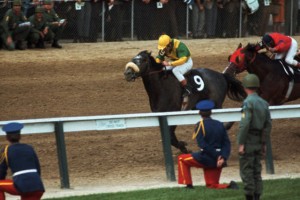
Dancer’s Image, nearing the finish of the 1968 Kentucky Derby
For several decades, phenylbutzone was pretty much the only NSAID available for use in horses. And everyone seemed happy. However, bute became somewhat notorious when, in the 1968 Kentucky Derby, the winner, Dancer’s Image, was disqualified after traces of the drug were found in a post-race urine analysis (while bute was legal on most tracks in the US in 1968, it had not yet been approved by Churchill Downs). Dancer’s Image is still the only horse to win the Kentucky Derby and then be disqualified.** Pretty much from that time forward, bute became associated with bad things, such as 1) Illegal drugs in horses, 2) horses injuring themselves, and 3) adverse side effects.
But drugs and performance horses is not what this discussion is about.
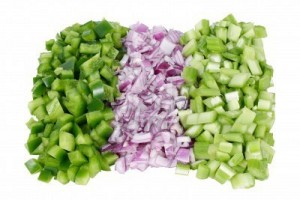
Peppers, onion, and celery – the holy trinity of creole and cajun cuisine. I make a mean gumbo.
When you think about a drug, it would be great if it satisfied some important criteria, the holy trinity of drug criteria, as it were. First, you’d like the drug to work. Second, you’d like it to be safe – no reason to use a product that works but that also is more likely than not to hurt your horse. And third, you’d like to be able to afford it. Satisfy those three things and you may really be on to something.
Bute fills all three.
1. It works. When it comes to diseases, pain and inflammation are two things that people typically like to try to manage. Lots of studies have shown that bute is an effective pain-reliever and anti-inflammatory for horses. In fact, it seems to be effective at lower doses than have been commonly advocated – in one study published in 2005, 2 grams once daily, given IV, were just was good as 2 grams twice daily, when it came to relieving lameness.
It also seems to work just about as well as anything else. That is, studies comparing bute to other drugs show that bute is as effective, or about as effective. There are certainly newer NSAIDs, but when it comes to relieving pain and inflammation, comparisons show that none of them is really much better than bute.***
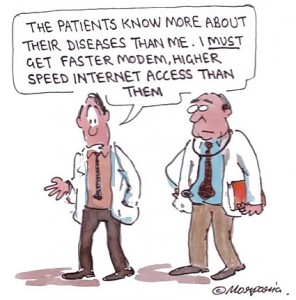 2. It’s remarkably safe. OK, now here’s where things get interesting. At this point in time, many horse owners have been “educated” that bute is a dangerous drug. Horse owners have learned that bute causes ulcers, and kidney problems, and the horses mouth to get “hard” and insensitive, and all sorts of other troubles. Maybe. Sometimes. But rarely. In fact, the fear of the side effects of bute has caused some folks to avoid it altogether, or even to characterize it as “poison.” It’s not. It’s not harmless, and it’s not perfect (nothing’s perfect), but it’s an incredibly useful drug for the treatment of pain and inflammation in the horse.
BRIEF ASIDE: This whole fear of side effects thing makes me a little crazy sometimes. Exaggerated fears cause people to do all sorts of irrational things, like not leave their homes. Ever (this condition is called agoraphobia). I wrote an article about side effects, and fears. You can read it if you CLICK HERE.
But back to the first sentence. Bute is REMARKABLY safe (in horses)**** That is, at recommended doses – and there are a truly remarkable number of doses of bute given every year – the reports of complications from bute are remarkably few. In fact, a 2009 study of 18 horses, given bute for 15 days found that, “When administered at the recommended label dose for 15 days, neither PBZ (bute) nor SBZ (another NSAID) causes an increase in the number or severity of gastric ulcers over what would be expected with traditional stabling and intermittent feeding patterns.” And there’s more – over the years, the recommended dosage has gotten halved, so horses are now getting 2 grams daily, instead of 2 grams twice daily, to the same effect. Smaller dose and even fewer side effects!
 “But what about all the complications?” you say.
It’s a good question. And you certainly don’t want to do anything to hurt your horse. But the thing is, most of the studies report complications when bute is given in doses beyond what is recommended. Cars are pretty safe, but they become much less safe when you drive them at twice the speed limit, or if you take short-cuts when you’re trying to repair them. The margin for error is thinner. Bute’s like that, too. If you overdo it, if you give it at higher doses than needed, for long periods of time, you increase the risk of problems.
ANOTHER ASIDE: Any substance that has an effect also has the potential to cause side effects. Otherwise stated, if there are no side effects, it is also unlikely that there are any effects at all. You can’t – or at least you shouldn’t – live your life in fear.
3. It’s really cheap. In fact, when it comes to an affordable drug, bute pretty much tops the list. A couple of grams of bute costs, what, $.20 – $.50 (depending on your location, of course)? And a couple grams of bute have been sufficient for to help horses with problems related to pain and inflammation for at least 40 years.
 When it comes to NSAIDs, it’s not like you don’t have choices. For most equine inflammatory drugs, there are “new and improved nsaids” that are said to be better. However, they may cost up to 20X more but aren’t necessarily any better, in just about any sense of the word, “better” (they don’t reduce inflammation more, they aren’t significantly better pain relievers, they don’t necessarily have fewer side effects – that sort of thing).
I’m not saying that bute is risk free. Bute, like any other drug, should be used appropriately, and with the advice of your veterinarian. I’m not saying that you should give it to your horse willy-nilly, either. The alternatives are much more expensive, but not necessarily much safer, or better. When it comes to “natural” pain relievers, they may be safe, but they are simply not very effective: not much of an alternative, really.. What I am trying to tell you is that avoiding a cheap, safe, and proven-effective drug because you’re worried that your horse is going to die, or is going to develop some life-threatening complication is just silly.
If your veterinarian says it’s OK, don’t worry too much about giving your horse a couple of grams of bute. Use the money you save on buying more expensive medications to buy some horse treats, and maybe a vanilla latté. You’ll both feel better.
_________________________________________________________________________________________
* If you’re a history buff – like I am – you might find the history of the discovery and development of anti-inflammatory drugs to be an interesting topic. In 2004, a great article about the topic was published in the journal Arthritis and Rheumatism – you can read it if you CLICK HERE.
** Suffice it to say that there is currently increased scrutiny on the use of drugs and performance horses, most recently as reported in the New York Times (you can see the article that caused all of the recent furor if you CLICK HERE).
*** Back in the 1960’s, the tested the pain-relieving effects of bute against a new compound called flunixin meglumine. The products worked about the same. Nevertheless, the new product was aggressively promoted by the company that made it as “THE” drug for colic. Hence, Banamine.® Tell me the advertising didn’t work.
**** The side effects of bute in people caused it to get removed from the market, and it’s not available for the treatment of people in the U.S . although it is still occasionally prescribed to people in the UK. Of course, people are not horses. Horses are not dogs either – you can read about that if you CLICK HERE.