 Colic is the most common medical problem affecting horses – in fact, something along the lines of 50% of the medical problems of the horse are described as “colic” (the “whys” of that would probably make a good article, in fact). Colic has been recognized in horses for a long, lone time, but it’s only fairly recently that have veterinarians have been able to accurately diagnosis, and effectively treat, colic cases. For example, Chinese observers of a few centuries back recognized the signs of colic, and saw that affected horses couldn’t defecate. They even wrote about the problem in an early 17th century text. However, since the Chinese didn’t understand the horse’s anatomy, they didn’t really know what was going on inside the horse. So, they concluded to effectively treat colic, a person should insert his arm into the horse’s rectum and attempt to remove feces from one of several “points” at which a blockage might occur.
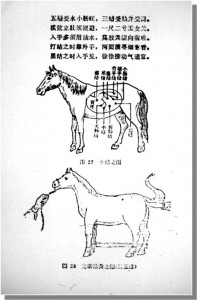 CURIOUS NOTE: These observations seem like a perfectly reasonable suggestion to me, given the state of knowledge at the time. I mean, if you feel around inside a horse’s abdomen, you do encounter different things in different areas of the abdomen. However, the idea that you could remove feces from “points” inside the horse’s abdomen to help cure colic gave rise to the modern myth that these points were “acupuncture points” to be used in the treatment of colic. Actually reading the text that came with the pictures in the book might have helped dispel that myth. Heck, even looking at the picture that came after the original “point” illustration would have helped, at least you’d think (see the illustration to the left).
Medical myths often get started with reasonable observations. However, whether those observations reflect anything that’s actually going on with the horse is a different question entirely. In fact, nonsensical information has a remarkable ability to stick around, even after there’s good proof that the information is nonsensical. Many myths about colic persist today – so let’s see if we can take on some of the more common ones, just for fun. You never know – it might give someone some peace of mind.
1. Horses do not seem to colic because the weather changes. It’s hot one day – it’s cool the next. Or the rain moves in. Your horse colics. What could be a more reasonable association? But the weather changes all of the time, and horses colic all of the time (being the most common medical condition of the horse). However, one seems not to have anything to do with the other – at least, not consistently, according to the studies. But since they both occur often, it’s easy to make a spurious association. Most studies have even shown that weather changes don’t cause colic. If you’d like to see a few of the studies, including one outlier that does show an association, CLICK HERE, CLICK HERE, CLICK HERE, and CLICK HERE.
That said, I’m not sure what you would do with information that weather changes cause colic if it were true. The colic-weather thing kind of reminds me of the old joke about the silly person who, upon finding out that most automobile accidents occur within 25 miles of your home, moved. The association between weather and colic isn’t confirmed, but it’s not something that you could do anything about, even if it were true. I don’t really worry much about things like that.

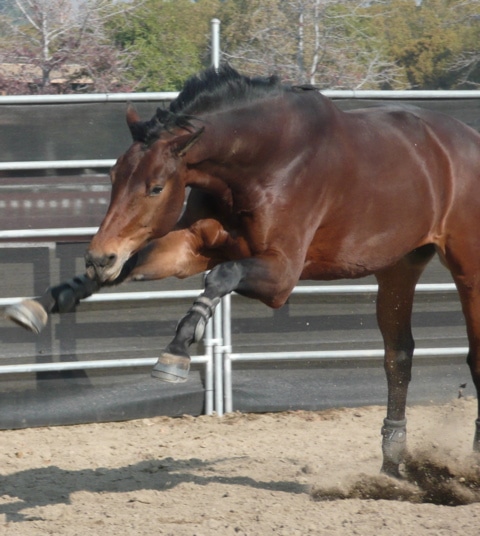
Diver, in mid-air, not about to twist her intestines.
2. Horses don’t twist their intestines when they roll. Have you ever seen a horse lie down and roll, happily scratching his back and rubbing his sides in the dirt? Have you ever seen that same horse develop a twisted intestine afterwards? Didn’t think so.
Horses that are uncomfortable from the pain of colic will often lie down and roll. They are trying to find a way to get comfortable, just like when you lie down on the couch after, say, a bad meal. Horses with colic pain will often change positions and roll around. They’re just trying to get comfortable: trying to get away from the pain.
This is another curious observational fallacy. The pain that occurs from a twisted intestine is extreme. One of the ways that horses show extreme pain (from (volvulus, strangulation, entrapment, and such) is by rolling around. But it’s the twist that comes first, not the other way around. In human medicine, it’s thought that intestines twist around scar tissue, or maybe from the weight of feed – to my knowledge, no one knows if there’s anything like that in horses. If you’re really interested in this problem in humans, CLICK HERE to read a great article from MEDSCAPE.
If a horse is beating himself up from rolling around frantically in pain, there’s certainly ample reason to keep him from doing so. However, if your horse rolls, the gut isn’t in danger of twisting. In the worst cases, it probably has already.

“You want me to what?”
3. Walk your horse, no matter what. I think that the idea that horses need to be walked when they have a colic probably comes from the concern over twisting a gut. “If they can’t lie down, they can’t twist their gut,” is how the thinking must go, I guess.
However, walking is not directly therapeutic for a colic. If a horse is relatively comfortable lying down, there’s no real reason to get him up just so that he can walk. Imagine you, on the couch, feeling bad after that spicy food you ordered against your better judgment. How would you feel if someone came up to you and said, “OK, let’s go, we’re going for a walk.” That’s justifiable homicide, in my book.
That said, there may be some slight benefit to walking a horse with colic. It may help distract the horse with a mild case colic, and help him forget about his pain. It also gives the owner something to do until the veterinarian arrives!
QUICK ASIDE: In some cases, I will suggest that clients lunge their horse with colic. In my experience, if a horse has a colic related to the accumulation of gas in his intestines, sometime jostling things around seems to help. But one can go to far with this sort of thing – I have seen horses that were literally walked (or lunged) to death.
 4. Banamine® (flunixin meglumine) is a potent pain reliever for your horse with colic. When it was first released a few decades ago flunixin was heavily advertised as the drug to treat colic (with some beautiful illustrations and even a rather spectacular belt buckle given away as a promotion). Based on those advertisements, it seems that horse owners (and some veterinarians, apparently) learned that the drug is a “must” for treating horses with colic. In fact, some people even say that it is so potent that it works within minutes of its administration, (which, given what we know about how the drug works, isn’t even possible).
The scientific evidence doesn’t back up the idea that flunixin is a very potent drug, and it certainly doesn’t seem to be a “must” for treating a horse with colic. In fact, experimental studies on the drug have shown that it’s not very effective at all at treating the pain of colic (CLICK HERE). Flunixin is a useful drug in certain circumstances, but it’s not a miracle drug for anything. I don’t suspect these facts will dampen its use, however.
NOTE: There’s no reason at all to give any drug for any condition, without a proper diagnosis. If you have flunixin in a medicine chest or tack box, I personally don’t think you should give it to your horse with colic without consulting with your veterinarian first. That said, it often is.
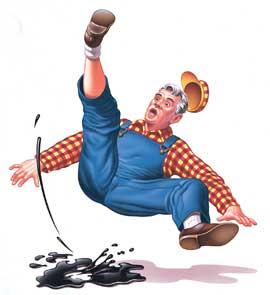 5. You have to oil ’em. For – well, forever – when a horse has had a colic, people have given him light mineral oil. But syringe. But nasogastric tube. in bran. Somehow. And…. it’s probably not very effective.
The idea seems to be that some horses colic because the manure gets “stuck” in the intestines (sometimes, it sort of does). The rationale seems to have been that the only thing that’s keeping a horse with colic from defecating is that the tube needs some lube. But that’s not how things work. Research pretty conclusively suggests that horses that have manure plugging up the tube need fluids, not oil. When you think about it, that makes some sense. Put a ball of horse manure in light mineral oil and it…. just sits there. Put it in some water and if falls apart. Your horse’s hydration is far more important in cases of colic than is the slipperiness of his intestinal tract. Your veterinarian can help you here, with both oral and intravenous fluids. It doesn’t hurt to oil ’em… it’s just probably not as important as everyone used to think.
 6. Add “alternative” treatments to help your horse with colic. Some people may add things such as acupuncture or massage to their efforts to help a horse with colic. Others may add any number of supplements that are said to help prevent colic, or do such things as “aiding” in digestion. Keeping horses is expensive enough – save your money.
In general, there’s no evidence at all to indicate that any “alternative” things are helpful, either in the prevention or treatment of colic.* In the case of acupuncture, there’s good evidence that it doesn’t help at all (CLICK HERE). If your horse has a colic, focus on getting quick and proper diagnosis and treatment. Don’t look for any “alternatives” to that!**
When it comes to colic, the two most important things to keep in mind that 1) It’s the most common medical condition of the horse, and 2) most cases of colic will resolve on their own. Sometimes medical treatments really do help – and sometimes horse horse will need surgery, but most horses do get better (of course, there are many individual exceptions). Adding treatments that lack evidence of effectiveness only adds to your costs, not to mention adding to your anxiety. Of course, if you’re worried – and in some cases, you certainly should be – you should always consult with your veterinarian. Keeping a level head is always the best way to go!
*****************************************************************************************************************************
* One could argue about the usefulness of giving horses psyllium to treat or prevent colic caused by sand accumulation. I don’t really think of that as an “alternative” treatment, but I thought I should mention it. I really don’t think it does much – the best way to prevent sand accumulation is to try to keep your horse from eating sand.
** You may have noted that some supplement companies are now offering to pay for part of your horse’s colic surgery if he has a colic while on the supplement. This is really cagey marketing. The fact is that most horses that colic don’t need surgery. So, if you could somehow get everyone with a horse to buy your supplement regularly, and then absorb some of the cost of the occasional surgery, you’d be money way ahead – and even farther ahead, depending on your markup. If you’re really worried about paying for colic surgery, just buy insurance. It will be way cheaper in the long run.