
As you may have noticed, there are a whole bunch of products out there that can be given to your horse. I think that a lot of people find this very confusing, so I thought I’d try my best to clear things up.
NOTE: Regulations may be somewhat different in your country if you’re not in the United States. But similar rules undoubtedly apply. Check with an authority if you’re not sure.
 Products can basically be divided into 4 categories:
- FDA-approved drugs
- Generic drugs
- Compounded medications
- Dietary supplements.
Even though these products may appear similar from the perspective of a horse owner – they’re all attractively packaged, and make interesting, if not always clear, claims – they are actually quite different. These differences are important. They include not-so-little things like regulatory oversight, evidence of safety and efficacy, manufacturing standards, and legal status. I think it’s really important for you to understand what you’re getting when you’re buying some produce for your horse – I would assume to don’t want to just feed him something to your buddy and just hope for the best. The choice of product of which sort of product you use can affect treatment outcomes, medication safety, competition compliance, and even the welfare of your horse.
FDA-Approved Drugs
 Let’s start at the top. FDA-approved drugs represent the highest level of regulatory oversight in veterinary medicine. In the United States, veterinary pharmaceuticals are regulated by the Center for Veterinary Medicine (CVM) within the U.S. Food and Drug Administration (FDA).
To obtain approval, a pharmaceutical company must submit extensive evidence demonstrating that the drug is:
- Safe for the horse when used according to label directions.
- Effective for the intended indication.
- Manufactured consistently according to Good Manufacturing Practices (GMPs).
- Properly labeled with dosage, warnings, contraindications, and directions for use.
 The approval process typically requires laboratory studies, pharmacokinetic investigations, controlled clinical trials, manufacturing inspections, and post-market surveillance plans. Otherwise stated, the companies that sell FDA-approved drugs have to spend a bunch of money to show that their product does what it says and that the active ingredients actually have to be in the package. Then, the company has to follow-up to make sure that there aren’t a whole bunch of adverse effects. If you’re a horse owner, that should hopefully provide at least a little bit of reassurance.
Examples of FDA-approved equine drugs include (NOTE: I’m not endorsing any of the following products):
- Omeprazole paste (GastroGard®) for treatment of equine gastric ulcer syndrome.
- Firocoxib (Equioxx®) for management of equine osteoarthritis.
- Pergolide mesylate (Prascend®) for pituitary pars intermedia dysfunction (PPID).
 Since there are so many hoops that have to be jumped through before they can be sold, everyone should have a fairly high degree of confidence regarding potency, purity, effectiveness, and safety when FDA-approved products are used according to label instructions, and, as you will see, particularly when compared to some other stuff that you can buy for your horse.
The problem for horse owners is that FDA approval takes a lot of time and money. As a result, relatively few drugs are specifically approved for horses, especially when compared with those available for humans or companion animals. It’s just a fact that horses are a comparatively small market and if you’re going to dump a lot of money into testing product, you’d like to be able to sell a lot of it. In addition, if you’re going to spend a lot of money proving that something works, you’re going to have to try to get it back, that is, you, the horse owner, is going to have to pay for it.
Generic Drugs
Generic drugs are FDA-approved products that contain the same active ingredient as a previously approved brand-name drug. When a company gets a drug approved by the FDA, those companies are protected for a certain amount of time from other folks that want to make the same product. In the U.S., a patent lasts 20 years from the earliest non-provisional filing date (not from FDA approval). But because clinical trials and FDA review often take 8–12 years, many drugs have only 7–12 years of patent life remaining after they reach the market. After the patent life expires, other manufacturers may seek approval to market equivalent versions.
 To receive FDA approval, generic drugs still have to be tested. A generic veterinary drug must show:
- Pharmaceutical equivalence to the pioneer drug.
- Bioequivalence, meaning it reaches similar concentrations in the body over time.
- Comparable manufacturing quality standards.
- Similar labeling and dosage instructions.
Generic manufacturers generally do not need to repeat all of the original efficacy studies, since effectiveness was already established by the company that came up with the product in the first place.
There are many examples of generic drugs in equine medicine, including generic formulations of:
- Phenylbutazone
- Pergolide (Zygolide® is a new generic)
- Firocoxcib (generic for Equioxx®)
- Flunixin meglumine (the original formulation is sold as Banamine®)
- Trimethoprim-sulfadiazine (or, SMZ tabs, as they are known around the barn)
- Various deworming products
 Since generics are also approved through an FDA review process, it’s reasonable to expect that the generic product is going to work just as well as the original branded product. The primary advantage of generic products – and it can be a significant advantage to budget conscious horse owners – is lower cost. Minor differences may exist in inactive ingredients, flavorings, preservatives, or formulation characteristics, however, these differences don’t really affect clinical performance. Still, some horses may not like a new flavor because they are, well, horses, and they usually try their best to make things as difficult as possible for their owners.
Compounded Medications
Compounded medications occupy a different regulatory category from the first two. A compounded drug is created by a pharmacist or veterinarian by combining, mixing, diluting, concentrating, or otherwise altering ingredients to meet the needs of an individual patient. For example, sometimes horses often require dosages, formulations, or combinations that are not commercially available.
Examples include:
- Custom oral suspensions for foals
- Alternative dosage forms for horses unwilling to accept tablets. For example, SMZ tabs can be compounded into a paste that a horse owner can sometimes wear after attempting to squirt it in their horse’s mouth.
- Ophthalmic preparations formulated for specific patients.
- Drugs that are temporarily unavailable because of manufacturing shortages.
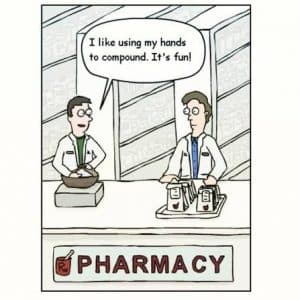 A big, important difference between compounded medications and FDA-approved drugs is that, simply-stated, compounded medications are generally not FDA-approved. That is, the final compounded product has not undergone FDA review for safety, efficacy, stability, or bioequivalence. That doesn’t mean compounded medications are necessarily ineffective or unsafe. Many are valuable clinical tools. However, their quality depends heavily on factors that you don’t know anything about, including:
- The source and quality of ingredients.
- The expertise of the compounding pharmacy.
- Appropriate formulation methods.
- Proper storage and handling.
 There have been studies evaluating compounded veterinary drugs (including one that I did a number of years back on compounded phenybutazone) that have found substantial variation in active ingredient concentrations in compounded products. Some products contain less drug than intended, while others contain more than labeled. Obviously, if you care about your horse getting the proper dose of an effective medication (which you should), this could be problematic.
Compounded medications are often cheaper than tested drugs. However, since you can’t necessarily be sure about a few things, compounding should probably not be used simply as a cheaper substitute for an approved drug when an approved product is available and suitable for use and administration. Compounding is intended to address specific patient needs that cannot be met by commercially available approved products, it’s not meant to be a pharmaceutical bargain. A compounded product may be less expensive, more convenient to administer, or flavored with a variety of delightful tastes, but the fact is that you’re not as sure of what you’re getting.
Dietary Supplements
 Dietary supplements are a whole ‘nother kettle of fish. Supplements among the least regulated products in the horse industry (heck, in any industry). There are tons of them (quite literally). Supplements include products marketed for (in no particular order, and certainly not limited to) joint health, hoof quality, digestive function, appetite support, kidney support, muscle development, calming behavior, respiratory health, the Immune system, and performance enhancement… I have to stop. ChatGPT gave me a list of 29 things that supplements can “support” or “enhance” or whatever glowing verbiage the advertisers can come up with.
Here’s the big, important difference, between FDA-approved drugs and supplements. Supplements are generally not required to demonstrate that they actually do anything before they can be marketed to horse owners. Supplement manufacturers simply do not need to provide evidence that the products do what the label suggests that they do. As a result, scientific support for equine supplements is remarkably uneven, and generally lacking. Some products do seem to have a bit of research behind them (of variable quality), while others rely largely on anecdotal reports, theoretical mechanisms, whims, and prayers.
A QUICK ASIDE: Exactly when did the horse go from a creature that was so healthy as to be able to coin its own phrase (as healthy as horse, originating in the mid-19th century, along with other phrases such as “fit as a horse”) to one that needs to be supplemented to provide an apparently limitless amount of “support?”
It’s not just the lack of scientific support that’s problematic, either. There’s also no required manufacturing standard to ensure product consistency. As a result, independent studies (including one that I did a number of years back on joint health products) have sometimes identified significant discrepancies between what the label says is on the product and the actual ingredient content. This problem also occurs with herbal and botanical products, which can vary depending on sourcing and manufacturing practices. When it comes to supplements, you pays your money and you takes your chances.
ONE MORE ASIDE: “You pays your money and you takes your choice,” first showed up in print in the British humor magazine Punch in 1846, inside a cartoon titled “The Ministerial Crisis” where a showman speaks to a customer. It apparently comes from a Cockney street dialect. This is so much more than just a horse health column. 😊

HERE’S WHAT I’D RECOMMEND
When you’re selecting some sort of a therapeutic product for you to use for your horse, here’s how I look at things.
- FDA-Approved Brand Drugs have the highest level of evidence and oversight. They’re proven safe and effective, and they have consistent manufacturing standards. That said, they’re also the most expensive, mostly because the companies have to offer some proof that they do what they say.
- FDA-Approved Generic Drugs have the same safety and efficacy expectations as do the Brand drugs. They tend to cost less, too.
- Compounded Medications can be useful, say, when there’s not an approved product available (for example, a powdered form of a product that is otherwise only available by injection). They can be useful, but you have to be aware that the quality and stability can be variable, and there’s little in the way of formal evidence for the compounded preparation itself. Even though supplements are widely available and commonly used, I essentially never recommend any of them unless it is a specific supplement for a specific purpose (e.g., selenium for horses in selenium-deficient areas). The claims made for most supplements are generally glowing and optimistic, (I mean, you probably wouldn’t buy them if they said, “We have no idea if this will actually do anything, and there may not really be anything in there, but isn’t the label pretty?”) but the overall lack of scientific evidence and lack regulatory oversight means that I just don’t feel comfortable prescribing them. Plus, horse owning is expensive enough anyway without throwing more money on something that can’t be shown to work.
OH, IF YOU HAVE A PERFORMANCE HORSE

be careful
These distinctions can be especially important if you have a horse that goes to horse shows. Racing commissions, the United States Equestrian Federation (USEF), the Fédération Équestre Internationale (FEI), and other regulatory bodies may regulate or prohibit specific substances regardless of whether they are approved drugs, compounded products, or supplements. Assuming that you care about such things as regulations (some people seem not to), supplements in particular may contain ingredients that trigger positive drug tests, particularly when products contain undeclared substances or contaminants. In that same vein, compounded medications can create a bit of uncertainly because there’s usually no pharmacokinetic data on them to help guide withdrawal times. That’s why, when it comes to competition horses, I prefer products with known composition and documented pharmacologic characteristics whenever possible.
IN SUM
When it comes to selecting some product for their horses, the challenge is to balance evidence, practicality, cost, the needs of the horse, and regulatory considerations when selecting the most appropriate product. Hopefully, this article has helped you understand the strengths and limitations of these four categories so that you can make rational therapeutic decisions. That’s important not only for treatment effectiveness, but also for the welfare of your horse!