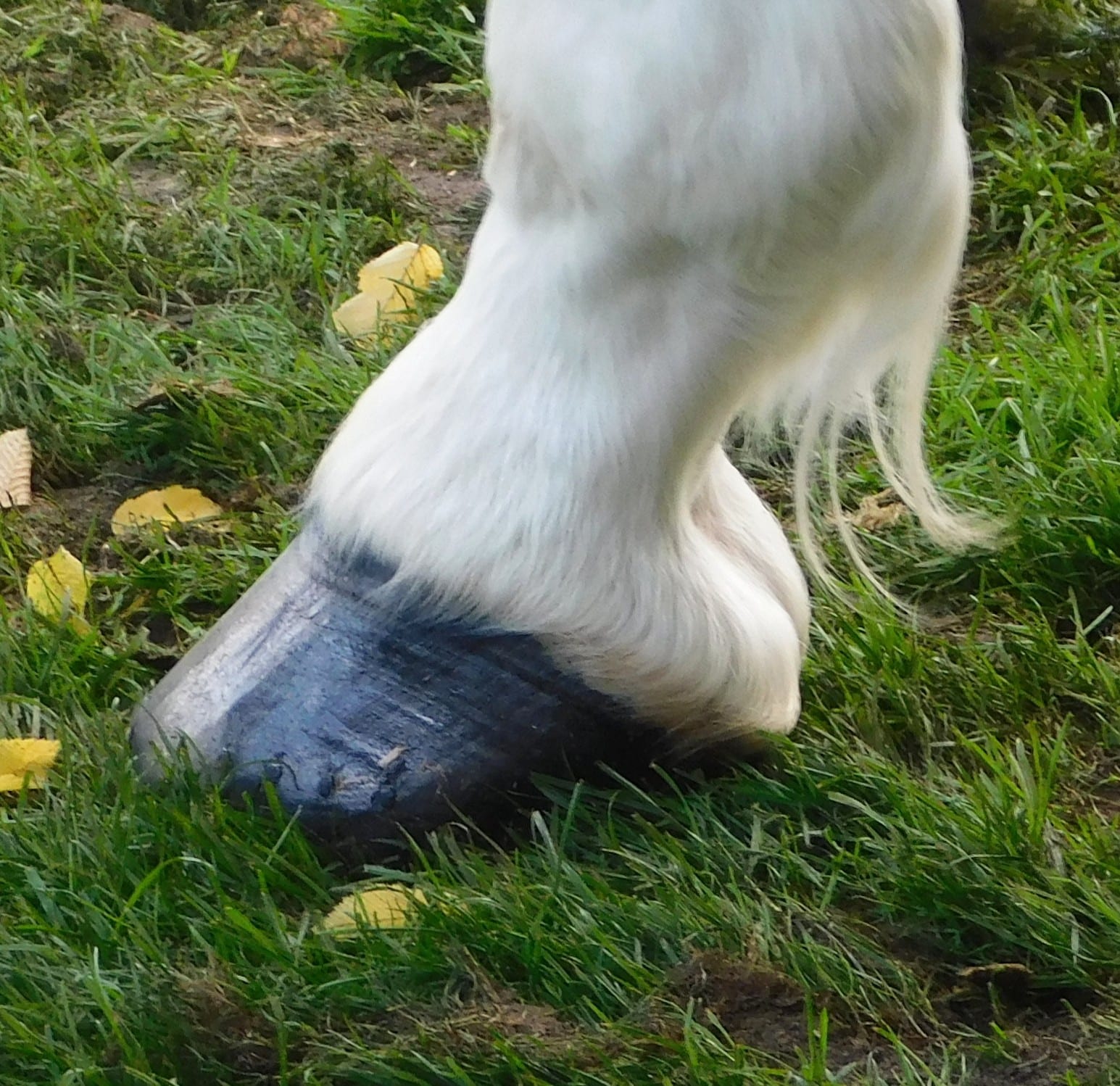
As we move up the horse, next in line is the horse’s pastern. Relative to other parts of the horse’s legs, I feel like I see fewer problems related to the pastern, but maybe that’s just the population of horses that I see. The pastern problems that I do see tend to fall into one of four categories.
 BUT FIRST… ever wonder why it’s called the “pastern?” Well, I did, so… as it turns out, it’s a really old word, dating all the way back to the Latin word, pastoria, referring to herdsmen (and which also gave us the word pastor meaning both someone who took care of sheep, and, more recently people, in a spiritual sense). But in the last 13th century, there was an old French word, pastron, which referred to a “shackle fixed on the foot of a horse or other beast.” Today, we’d call that a “hobble.” Regardless, by 1520, the meaning of “pastern” was extended to be the part of the horse’s leg between the fetlock and the hoof; the part where you buckled the tether to keep the horse from running off when he was let out to graze. In essence, the pastern was the part where the “pastor” (shepherd) buckled the pastron. And so it remains. In the horse world, old words (and for that matter, many old ideas) never seem to die.
 But back to the horse. Here are the four main things I see (there are certainly more, of course, like mange, in draft horses, but I don’t really see many draft horses).
- Dings, scrapes, and cuts
- Dermatitis
- Fractures
- Arthritis
DINGS, SCRAPES, AND CUTS
Being close to the ground, the pasterns get subjected to all sorts of trauma. Scrapes from the ground. Knicks from solid objects. Getting whacked by shoes. Wires on the ground. You know. It’s always something.
Dings, scrapes, and cuts (let’s call them DSC, to save my fingers) can be really annoying to deal with in the pastern because 1) The skin is pretty tight around the pastern, and 2) They often get rubbed into the dirt and much pretty thoroughly before anyone sees them. Tight skin means that it can be hard to put pastern wounds together, especially if the tissue is swollen, or a chunk of skin is lost, and rubbing a wound around in the muck is a great way to start a wound infection, and impede healing. Sometimes pastern wounds are a simple matter of cleaning and bandaging – sometimes they’re pretty complicated. It’s always a good idea to get your veterinarian involved when anything gets complicated!
DERMATITIS
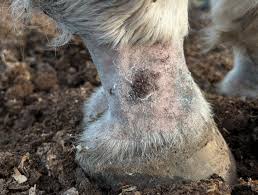 Pastern dermatitis is one of those conditions that looks deceptively simple. It goes by a lot of catchy names, such as “mud fever,” “scratches,” or “greasy heel,” but the condition quickly becomes even more messy once you try to pin down the cause and treatment. The term, “Pastern dermatitis,” is not a diagnosis; it’s a clinical syndrome affecting the skin of the pastern and fetlock.
Pastern dermatitis refers to inflammation of the skin – usually on the back of the pastern, characterized redness, scaling and crusting, oozing, pain, swelling, and, in severe cases, lameness. You’re probably better off thinking of pastern dermatitis as a reaction pattern rather than a single disease. People tend to want to make pastern dermatitis a simple diagnosis, but this is where they can get into trouble. There are some common factors, however.
-
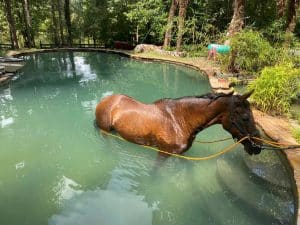
Eventually, this will lead to pastern dermatitis
Excessive and prolonged moisture. Moisture gets the skin soft and disrupts the normal barrier of the skin surface. At that point, disease causing organisms can get in and go to work.
- Draft breed, and breeds that have long feathers on their lower legs can get external parasites, such as mange mites. It looks like an infection, but it won’t resolve unless the mites get treated.
- Contact irritation or sensitivity. The pasterns can get irritated from bedding, such as treated wood shavings, or from stuff put on them, such as tea tree oil-containing products. There’s also a type of dermatitis that is aggravated by light, especially in horses with lightly pigmented skin.
- Immune-mediated disease, such as pemphigus foliaceous. These conditions can look like a simple infection, but they are much different (and usually much harder) problems to deal with.
You want to get on cases of pastern dermatitis quickly, of course. Like any other medical problem, the more quickly it’s recognized, the more likely it is you’ll be able to quickly do something about it.
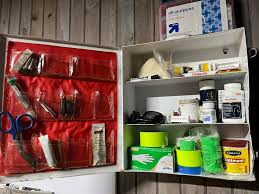
You do have choices
For many cases of pastern dermatitis, a quick look, a simple diagnosis, and daily treatment can work out just fine. In more complicated cases, you may need to dig deeper by taking a good history, maybe doing some skin scrapings or biopsies, or even maybe try to culture the organism(s) that up causing the problem. If you don’t identify the cause, it can be a real challenge sometimes to come up with a cure.
“Just wash it and wrap it,” is a treatment prescription that can be effective in simple cases, but it can also fail. If you can’t get to the underlying cause – such as in chronic, proliferative forms – you may be looking at lifelong management rather than a real cure.
Still, “pastern dermatitis” is a good example of how conditions of the horse are often described by how they look, rather than what causes them. If you treat for bacteria, you may miss mites. If you treat for “scratches” you might miss an immune-mediate cause. If you just treat for inflammation, you might miss infection. So, when it comes to pastern dermatitis, the real question isn’t, “What should I put on it?” rather, it’s what combination of skin insult, infection, and response by the horse has resulted in what you’re seeing in your horse?
For more on “scratches” click on Dr. Ramey’s article HERE.
FRACTURES
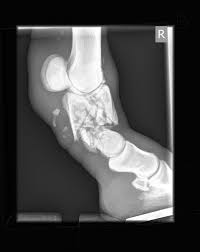
A horrible pastern fracture
The pastern can occasionally be a spot where some rather catastrophic fractures can occur. Most of these fractures occur when an extreme amount of stress gets put on the leg. The pastern, which is both 1) near the ground, where the forces concentrate, and 2) not that big of a joint, honestly, takes a whole lot of stress.
Fractured pasterns especially show up when a horse has to turn quickly. The leg can get stuck in the ground and when it twists, the pastern can shatter. If for no other reason, that’s why you need to be very careful when turning your horse out to run after he’s been cooped up in a stall. You can read about why you should be careful turning out your horse is you CLICK HERE
The good news – such as it is – is that a good number of horses with fractured pasterns can be returned to soundness by surgery (you don’t always have to put a horse with a broken leg to sleep). The prognosis for recovery depends on the fracture and whether the fracture occurs in a front or back leg (the prognosis is better in the back leg, since a back leg has to carry less weight), and surgery is expensive, but repair can be done (I take care of one horse in my practice who’s doing great as a trail horse after a right hind pastern fracture years ago).
ARTHRITIS
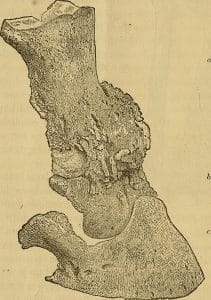
Ringbone, 1870 illustration
The last common problem of the pastern that we’ll talk about is osteoarthritis. The pastern is the site of one of the more colorfully named conditions of the horse, “ringbone.” Osteoarthritis is a fairly common (but never normal) condition, especially in older horses, where the protective cartilage that cushions the ends of bones in the horse’s joint(s) gradually wears down. Cartilage normally allows smooth, pain-free movement; when it breaks down, bones can rub against each other, leading to pain and stiffness. Osteoarthritis of the pastern is called “ringbone,” because when it was first described centuries ago, people noticed a “ring” of bone forming around the pastern joint and the name stuck. You can read a lot more about ringbone is you CLICK HERE.
There are certainly other problems that affect the horse’s pastern but these are the ones I most commonly have to deal with. Slowly, but surely, we’re moving up the front leg. The fetlock (ankle) is next.